
As I sit in the office on New Years Eve, slaving away on a project, I figured I should take some time and reflect on the last year. 2008 has been a whirlwind. A year ago, I was a staff coordinator at a great production company in San Diego. I had 8 producers to coordinate for, plus working on in house projects, a steady paycheck, and a nice apartment across the street from the Del Mar Racetrack. Not to mention, I was in the middle of post for my webseries, "Zed Lapel Pin."
Then I got the crazy idea that I should go freelance. In no time, I was working on reality shows and feature films. I started doing more work in LA and eventually got hired on by my friends at Llewellyn Films producing dramatic re-enactments for an interview show.
Now that we are in the waning hours of 2008, it feels good to look in the rearview mirror and see 14 episodes of TV show, 3 feature films, 3 spec commercials shot on RED, a pilot for a reality show, and many other projects. I cant wait to see what is ahead in 2009.
Wednesday, December 31, 2008


Sunday, November 16, 2008
The Chase
My third Doritos Super Bowl Commercial is online!!!!
Please check it out at www.crashthesuperbowl.comDirector: Chris Armstrong
Actors: Melissa Disney, Braxton Davis, Jeremy Searle, and Snowball
Production Company: Resolve Entertainment
Producers: Chris Roberts, Aaron Matthew Kaiser
Filmed with a RED ONE Digital Cinema Camera
This was the first commercial that we shot for the competition. And my first time working with trained animals.
Feel free to pass this link on to your friends!
http://www.crashthesuperbowl.com/#/gallery/video/1256/
Please check it out at www.crashthesuperbowl.comDirector: Chris Armstrong
Actors: Melissa Disney, Braxton Davis, Jeremy Searle, and Snowball
Production Company: Resolve Entertainment
Producers: Chris Roberts, Aaron Matthew Kaiser
Filmed with a RED ONE Digital Cinema Camera
This was the first commercial that we shot for the competition. And my first time working with trained animals.
Feel free to pass this link on to your friends!
http://www.crashthesuperbowl.com/#/gallery/video/1256/
Girl Fight
My second Doritos Super Bowl Commercial is online!!!!
Please check it out at www.crashthesuperbowl.com
Director: Wes Llewellyn with Ryan Mooney
Actors: Katie Eischen, Bethany Levy , Lonnie Colón, and William Spacer
Production Company: Resolve Entertainment
Producers: Chris Roberts, Aaron Matthew Kaiser
Filmed with a RED ONE Digital Cinema Camera
This was the second commercial that we shot for the competition and presented a fun challenge in shooting the fight sequence. The slow motion footage was shot at 120 FPS.
Feel free to pass this link on to your friends!
http://www.crashthesuperbowl.com/#/gallery/video/1244/
Please check it out at www.crashthesuperbowl.com
Director: Wes Llewellyn with Ryan Mooney
Actors: Katie Eischen, Bethany Levy , Lonnie Colón, and William Spacer
Production Company: Resolve Entertainment
Producers: Chris Roberts, Aaron Matthew Kaiser
Filmed with a RED ONE Digital Cinema Camera
This was the second commercial that we shot for the competition and presented a fun challenge in shooting the fight sequence. The slow motion footage was shot at 120 FPS.
Feel free to pass this link on to your friends!
http://www.crashthesuperbowl.com/#/gallery/video/1244/
Saturday, November 15, 2008
The Bold Burglar
My first Doritos Super Bowl Commercial is online!!!!
Please check it out at www.crashthesuperbowl.com
Director: Brad Bosley
Actors: Jeff Lorch, James McMann (Pushing Daisies)
Production Company: Resolve Entertainment
Producers: Chris Roberts, Aaron Matthew Kaiser
Filmed with a RED ONE Digital Cinema Camera
This was the third commercial that we shot for the competition and a great experiment in shooting low-light scenes.
Feel free to pass this link on to your friends!
http://www.crashthesuperbowl.com/#/gallery/video/1146/
Please check it out at www.crashthesuperbowl.com
Director: Brad Bosley
Actors: Jeff Lorch, James McMann (Pushing Daisies)
Production Company: Resolve Entertainment
Producers: Chris Roberts, Aaron Matthew Kaiser
Filmed with a RED ONE Digital Cinema Camera
This was the third commercial that we shot for the competition and a great experiment in shooting low-light scenes.
Feel free to pass this link on to your friends!
http://www.crashthesuperbowl.com/#/gallery/video/1146/
Thursday, November 13, 2008
Drinking the RED cool-aid
I know that I have been on the fence for a long time about the RED camera (now cameras). But now that I am nearly finished with post on my Doritos Commercials (which were shot on the RED One) and with the announcement today of the NEW specs for EPIC and SCARLET, I have to say I really like the RED camera. Even this last weekend while I was shooting Precepts Motorsports pre-run the Baja 1000 for a reality show presentation, I was wishing that I had a SCARLET to shoot on.
I'm not the only one drinking the cool-aid; earlier this afternoon I was discussing current projects and eating yogurt with my good friend and cinematographer Paolo Cascio, who has been fairly anti-RED since it came out. However, he just shot a PSA on RED for Tyler Perry and is very happy with how the shoot went and how amazing the footage is. You can see the PSA on his website under the "Cinematography Reel" www.pchollywood.com
We both agreed (from a producing and operator/technical standpoint) you have to approach a RED shoot like a film shoot. It truely is a "Digital Cinema Camera" not a video camera. If you try to schedule a video shoot, you will be very upset when you get behind schedule on your first day. Not to mention that when you get to post, the process is not as easy as popping in a P2 card and opening the log and transfer window. Like I just said, imagine it's film, only you dont have to ship it out to a lab for transfer, the first part of your post process is doing the work of the lab - and this is also where you start saving money because you can get these beautiful dalies in the comfort of your favorite edit suite.
Brandon Lippard Opperating the RED ONE Digital Cinema Camera for Doritos Spec Commercial

I'm not the only one drinking the cool-aid; earlier this afternoon I was discussing current projects and eating yogurt with my good friend and cinematographer Paolo Cascio, who has been fairly anti-RED since it came out. However, he just shot a PSA on RED for Tyler Perry and is very happy with how the shoot went and how amazing the footage is. You can see the PSA on his website under the "Cinematography Reel" www.pchollywood.com
We both agreed (from a producing and operator/technical standpoint) you have to approach a RED shoot like a film shoot. It truely is a "Digital Cinema Camera" not a video camera. If you try to schedule a video shoot, you will be very upset when you get behind schedule on your first day. Not to mention that when you get to post, the process is not as easy as popping in a P2 card and opening the log and transfer window. Like I just said, imagine it's film, only you dont have to ship it out to a lab for transfer, the first part of your post process is doing the work of the lab - and this is also where you start saving money because you can get these beautiful dalies in the comfort of your favorite edit suite.
Brandon Lippard Opperating the RED ONE Digital Cinema Camera for Doritos Spec Commercial

Friday, October 31, 2008
Doritos Crash The Superbowl Contest
A few weeks ago I had the bright idea to shoot a couple of spots for the Doritos Crash the Superbowl contest. Just get a few friends together, have some fun, shoot on RED, but nothing too serious. Fast forward to now: I just wrapped on three intense days of shooting three commercials with three different directors. Over the next week or so, I will post blogs about each of the individual commercials.
Needless to say, this project became much larger than I originally anticipated, but I was able to create several strategic partnerships that made these commercials come to life. First and foremost a huge thank you to Jeff Bartsch and Resolve Entertainment for Exec Producing the project and for allowing me to bring Aaron Matthew Kaiser and AntiKaiser Productions in to help with production. And as always much love to my production family at Llewellyn Films (Wes, Amanda, Lonnie, and Intern Luke) for providing production support (and mental support). Last but not least a special thank you to my good friend Scotty D. for having the right part at the right time, several times.
Thank you to my entire crew, who worked incredibly hard for three days. Thank you to all of the actors who lent us your talents.
Credits:
Exec Producer: Jeff Bartsch - Resolve Entertainment
Producer: Chris Roberts - Chris Roberts Productions
Co-Producer: Aaron Matthew Kaiser - AntiKaiser Productions
Directors:
Chris Armstrong - "The Chase" Staring: Jeremy Searle, Melissa Disney, and Braxton Davis
Wes Llewellyn with Ryan Mooney- "Girl Fight" Staring: Lonnie Colón, Bethany Levy, Katie Eischen, and William Spacer
Brad Bosley - "Bold Burglar" Staring: James McMann, and Jeff Lorch
Crew:
Director of Photography: Brandon Lippard
First AC: Cameron Riddles
Gaffer: Eric Boland
Grip: Will Demeritt
Audio: Matt Burgette
Make-up: Tara Lang
DIT: Sarah Sanders
Stunt Coordinator: Ryan Mooney
Script Supervisor: Adria Castillo
Key PA: Intern Luke
PA: Jo Correy
Needless to say, this project became much larger than I originally anticipated, but I was able to create several strategic partnerships that made these commercials come to life. First and foremost a huge thank you to Jeff Bartsch and Resolve Entertainment for Exec Producing the project and for allowing me to bring Aaron Matthew Kaiser and AntiKaiser Productions in to help with production. And as always much love to my production family at Llewellyn Films (Wes, Amanda, Lonnie, and Intern Luke) for providing production support (and mental support). Last but not least a special thank you to my good friend Scotty D. for having the right part at the right time, several times.
Thank you to my entire crew, who worked incredibly hard for three days. Thank you to all of the actors who lent us your talents.
Credits:
Exec Producer: Jeff Bartsch - Resolve Entertainment
Producer: Chris Roberts - Chris Roberts Productions
Co-Producer: Aaron Matthew Kaiser - AntiKaiser Productions
Directors:
Chris Armstrong - "The Chase" Staring: Jeremy Searle, Melissa Disney, and Braxton Davis
Wes Llewellyn with Ryan Mooney- "Girl Fight" Staring: Lonnie Colón, Bethany Levy, Katie Eischen, and William Spacer
Brad Bosley - "Bold Burglar" Staring: James McMann, and Jeff Lorch
Crew:
Director of Photography: Brandon Lippard
First AC: Cameron Riddles
Gaffer: Eric Boland
Grip: Will Demeritt
Audio: Matt Burgette
Make-up: Tara Lang
DIT: Sarah Sanders
Stunt Coordinator: Ryan Mooney
Script Supervisor: Adria Castillo
Key PA: Intern Luke
PA: Jo Correy
Tuesday, September 2, 2008
In A World That Lost Its Voice
Don La Fontaine, (Aug. 26, 1940 - Sept. 1, 2008)
The man famous for the catch phrase, "In a world..." has left this world a quieter place. Known as the voice of the movie trailer and the "King of Voice Over," LaFontaine passed away at Cedars-Sinai Monday afternoon. Quite possibly SAG's busiest actor, Don worked on several thousand films, and even more commercials for companies such as GEICO, Ford, GM, Coke and almost every three-letter TV channel under the sun.
"I think it was kinda a comfort to hear his voice all the time in previews," said movie-goer Doug Fruehling, "for me it was part of the movie-going experience, 'oh, yeah, it's that guys voice again.'"
Fellow voice over artist Mick Wingert (also represented by TGMD) recalls, "Don Lafontaine was not only a master in the field of voice-over, but he was also a notoriously generous man."
Don has left quite a legacy, and a defening silence.
Official Statement from the family.
The man famous for the catch phrase, "In a world..." has left this world a quieter place. Known as the voice of the movie trailer and the "King of Voice Over," LaFontaine passed away at Cedars-Sinai Monday afternoon. Quite possibly SAG's busiest actor, Don worked on several thousand films, and even more commercials for companies such as GEICO, Ford, GM, Coke and almost every three-letter TV channel under the sun.
"I think it was kinda a comfort to hear his voice all the time in previews," said movie-goer Doug Fruehling, "for me it was part of the movie-going experience, 'oh, yeah, it's that guys voice again.'"
Fellow voice over artist Mick Wingert (also represented by TGMD) recalls, "Don Lafontaine was not only a master in the field of voice-over, but he was also a notoriously generous man."
Don has left quite a legacy, and a defening silence.
Official Statement from the family.
Thursday, August 7, 2008
More Buzz about RED

Not only did I recently work on a feature shot on the 4K RED ONE, but last night I went to a screening of the first feature film shot completely on RED in the southern hemisphere. The event was hosted by USC and RED, which -- with this film -- may be getting closer to claiming its first commercially released feature film offspring. (A big thank you to my filmmaker/publicist friend Scotty D. for getting me in.)
"The Nothing Men," is the freshman project from Australian film company Alchemy Film Productions, about a group of displaced machine shop grunts who are pining for their severence checks. It was written and directed by Mark Fitzpatrick, who told us he opted to make the film himself even as major Hollywood producers and actors (Gale Anne Hurd, Jeff Goldblum, etc.) came calling for his script. Not only were the producers (Martin Dingle Wall and Andrew Windsor), director, and DP (Peter Holland) on hand to answer questions after the film; Ted Schilowitz was also there to answer technical questions about the camera and workflow. Techs from RED were available after the screening, too, to answer questions.
Overall, I think "The Nothing Men," was a good film. It got off to a slow/rough start, but the last 60 min. almost makes you forget about the first 30. The scenes are well lit, the actors give excellent performances (possibly Academy caliber [AMPAS, Australian Film Institute, or BAFTA]), and once the characters really start interacting and the plot starts developing the film is quite captivating. In fact, even Ted said when he viewed the film prior to last night's event he "stopped watching the RED after the first three or four minutes and started watching the film."
Lest anyone get the idea that I am jumping on the RED band wagon, I am still not sold completely on the technology. I still have my reservations about on-set asset management and post workflow. And I will always be more comfortable with the idea of having my film "in the can" or on tape stock. (Even the producers said that during pre-production they weren't sure, due to ambivalence about the as-yet-unproven RED camera [Build 8], they would be able to secure a completion bond. Despite this risk they still shot on RED and it looks amazing.) But, as long as the beers are on RED, the camera has come along way and is definitely becoming progressively better with each new build. Not to mention that Scarlet (3K) and Epic (5K) will be coming out next year.
[Edited by Scotty D.]
Monday, July 28, 2008
When I'm not producing...
I'm still producing.
I went on "vacation" last week. My dad, some friends, and I went backpacking for 5 days and climbed Mt. Whitney.
However, while I was waiting for the rest of our party to arrive in Lone Pine, CA to get our wilderness permits, I wandered in to the Beverly and Jim Rodgers Museum of Lone Pine Film History. Not only did I get a feel for what movies had been shot in the area (everything from The Lone Ranger TV series to all four Tremors movies, to scenes in Ironman) but I also met with the Lone Pine film commissioner, Chris Langley.
My meeting with Chris was a great chance to get the inside scoop on resources in the area both for crew and locations. We were also able to talk about several projects that I am developing and what resources Lone Pine might be able to offer.
Long story short, you never know what opportunities may present themselves, so ALWAYS be ready to network.
I went on "vacation" last week. My dad, some friends, and I went backpacking for 5 days and climbed Mt. Whitney.
However, while I was waiting for the rest of our party to arrive in Lone Pine, CA to get our wilderness permits, I wandered in to the Beverly and Jim Rodgers Museum of Lone Pine Film History. Not only did I get a feel for what movies had been shot in the area (everything from The Lone Ranger TV series to all four Tremors movies, to scenes in Ironman) but I also met with the Lone Pine film commissioner, Chris Langley.
My meeting with Chris was a great chance to get the inside scoop on resources in the area both for crew and locations. We were also able to talk about several projects that I am developing and what resources Lone Pine might be able to offer.
Long story short, you never know what opportunities may present themselves, so ALWAYS be ready to network.
Wednesday, July 2, 2008
Zed Lapel Pin Website
 There is no better feeling, as a producer, than finishing a project. The stress falls off of your shoulders and you have a sense of completion. You know that your last weeks, months, or even years have paid off and you have something to show for your time and money spent.
I carry around a piece of paper in my wallet with four things that a friend once told me about working on a project.
"Live your project."
"Love your project."
"Finish your project."
"Regardless."
I am very proud to announce that the website for my webseries, Zed Lapel Pin, is live. You can view it here: www.zedlapelpin.com

Back in October of last year, Chad Clabaugh and I started talking about creating a story about an air guitar cover band. In December we shot for three days in San Diego with an incredible cast and crew. And for the last six months Chad and I have been working on post and getting the website built. Please check out the Zed website and dont forget the Links page.
Special thanks to Ronnie Swietek, MA5EN Photography, and EPIC Make-up.

Monday, June 23, 2008
2 for 1 day!
Just because I love my readers so much, you get 2 blogs in 1 day! The last few weeks have been very exciting for me. For those of you who dont know, I am working mainly in LA now producing segments for "It's Supernatural" with Sid Roth. Currently I am in San Diego on my second week on a feature shooting in Oceanside. I am also in development on several other features. I have also had the chance to work on a couple of reality show pilots and for ESPN. Special thanks to Eric Mandel (an awesome cameraman - and full production services supplier) for getting me on some very cool jobs.
As a producer, you are only as good as the people in your rolodex and I pride myself on working with some of the best.
As a producer, you are only as good as the people in your rolodex and I pride myself on working with some of the best.
Tuesday, June 17, 2008
Producers Toolbox: On the Bookshelf

Returning to the topic of books that I use on a regular basis, "The Complete Film Production Handbook - Third Edition" by Eve Light Honthaner, is my Bible in the production office. This book has just about any form you will ever need for production. Whether you are doing Station 12's for SAG actors or you just need a walkie sign out sheet, the Handbook will not only teach you how to fill out the forms, give you examples of them, but it also comes a CD-ROM of blank forms.
I have used this book and the forms in it on everything from corporate videos to music videos to feature films. It is a great reference to have on hand if you need a quick read on how to perform certain procedures, plus it gives examples of how to fill out every form in the book.
The included CD-ROM alone makes the book worth its $60.95 price tag. Each form in the book is available in Microsoft Word format and is completely customizable for any production, no matter how big or small.
Tuesday, May 27, 2008
My Favorite Thing!
I shared this story with a director friend of mine, Wes Llewellyn, it is a day-in-the-life of a cat and a dog. He now regularly encourages anyone in the business, especially indie film makers, to live life like the dog.
CAT DIARY
Day 983 of my captivity.
My captors continue to taunt me with bizarre little dangling objects.
They dine lavishly on fresh meat, while the other inmates and I are fed hash or some sort of dry nuggets. Although I make my contempt for the rations perfectly clear, I nevertheless must eat something in order to keep up my strength. The only thing that keeps me going is my dream of escape.
In an attempt to disgust them, I once again vomit on the carpet.
Today I decapitated a mouse and dropped its headless body at their feet. I had hoped this would strike fear into their hearts, since it clearly demonstrates what I am capable of. However, they merely made condescending comments about what a 'good little hunter' I am. Bastards!
There was some sort of assembly of their accomplices tonight. I was placed in solitary confinement for the duration of the event. However, I could hear the noises and smell the food. I overheard that my confinement was due to the power of'allergies.' I must learn what this means, and how to use it to my advantage.
Today I was almost successful in an attempt to assassinate one of my tormentors by weaving around his feet as he was walking. I must try this again tomorrow -- but at the top of the stairs.
I am convinced that the other prisoners here are flunkies and snitches.
The dog receives special privileges. He is regularly released - and seems to be more than willing to return. He is obviously retarded.
DOG DIARY
8:00 am - Dog food! My favorite thing!
9:30 am - A car ride! My favorite thing!
9:40 am - A walk in the park! My favorite thing!
10:30 am - Got rubbed and petted! My favorite thing!
12:00 PM - Lunch! My favorite thing!
1:00 PM - Played in the yard! My favorite thing!
3:00 PM - Wagged my tail! My favorite thing!
5:00 PM - Milk bones! My favorite thing!
7:00 PM - Got to play ball! My favorite thing!
8:00 PM - Wow! Watched TV with the people! My favorite thing!
11:00 PM - Sleeping on the bed! My favorite thing!
Many people wonder what the most important thing in making a movie is: the script? the acting? the lighting? the budget?
The answer is all of them. You can't build a successful movie without all of the pieces. Your production diary should read:
8:00 Wake up! My Favorite Thing!
10:00 Scriptwriting! My Favorite Thing!
12:00 Lunch Meeting! My Favorite Thing!
2:00 Screen Tests! My Favorite Thing!
3:00 Location Scout! My Favorite Thing!
5:00 Re-write budget for conference call in the morning! My Favorite Thing!
What ever you do, do it well and be excited about it.
CAT DIARY
Day 983 of my captivity.
My captors continue to taunt me with bizarre little dangling objects.
They dine lavishly on fresh meat, while the other inmates and I are fed hash or some sort of dry nuggets. Although I make my contempt for the rations perfectly clear, I nevertheless must eat something in order to keep up my strength. The only thing that keeps me going is my dream of escape.
In an attempt to disgust them, I once again vomit on the carpet.
Today I decapitated a mouse and dropped its headless body at their feet. I had hoped this would strike fear into their hearts, since it clearly demonstrates what I am capable of. However, they merely made condescending comments about what a 'good little hunter' I am. Bastards!
There was some sort of assembly of their accomplices tonight. I was placed in solitary confinement for the duration of the event. However, I could hear the noises and smell the food. I overheard that my confinement was due to the power of'allergies.' I must learn what this means, and how to use it to my advantage.
Today I was almost successful in an attempt to assassinate one of my tormentors by weaving around his feet as he was walking. I must try this again tomorrow -- but at the top of the stairs.
I am convinced that the other prisoners here are flunkies and snitches.
The dog receives special privileges. He is regularly released - and seems to be more than willing to return. He is obviously retarded.
DOG DIARY
8:00 am - Dog food! My favorite thing!
9:30 am - A car ride! My favorite thing!
9:40 am - A walk in the park! My favorite thing!
10:30 am - Got rubbed and petted! My favorite thing!
12:00 PM - Lunch! My favorite thing!
1:00 PM - Played in the yard! My favorite thing!
3:00 PM - Wagged my tail! My favorite thing!
5:00 PM - Milk bones! My favorite thing!
7:00 PM - Got to play ball! My favorite thing!
8:00 PM - Wow! Watched TV with the people! My favorite thing!
11:00 PM - Sleeping on the bed! My favorite thing!
Many people wonder what the most important thing in making a movie is: the script? the acting? the lighting? the budget?
The answer is all of them. You can't build a successful movie without all of the pieces. Your production diary should read:
8:00 Wake up! My Favorite Thing!
10:00 Scriptwriting! My Favorite Thing!
12:00 Lunch Meeting! My Favorite Thing!
2:00 Screen Tests! My Favorite Thing!
3:00 Location Scout! My Favorite Thing!
5:00 Re-write budget for conference call in the morning! My Favorite Thing!
What ever you do, do it well and be excited about it.
Tuesday, May 13, 2008
Chris Roberts Productions Website Now Live!!!!
After several months of work and the strange grey placeholder page being up, my new improved, and fully functional website is up. By fully functional, I mean we are still working out a few bugs but it is up and running and your comments are always welcome (not always listened to, but welcome non-the-less).
www.chrisrobertsproductions.com
Look for my web series "Zed Lapel Pin: A Rockumentary" coming soon.
www.chrisrobertsproductions.com
Look for my web series "Zed Lapel Pin: A Rockumentary" coming soon.
Saturday, April 26, 2008
Going Beyond the Call of Duty
A few weeks ago I was asked by my friends at Llewellyn Films to help produce a couple of segments for "It's Supernatural" with Sid Roth. The first episode that I worked on was an interview with Mary Nahas, daughter of Private John Galione and author of "The Journey of Private Galione."
Who is John Galione and why should I care you may be asking, here's the quick and dirty:
Towards the end of WWII, finding Nazi concentration camps wasn't a priority for the US military. But this didn't stop Private John Galione from going AWOL to look for the camps. What he discovered was the Mittelbau Dora camp. Dora was the camp where Heinrich Himmler was developing V-2 Rockets.
Had Galione not gone AWOL and found the camp, it would have been found by the Russians and changed the face of the Cold War.
Annnnd now you know!
I was the San Diego location producer for the re-enactments of parts of Galione's story. We filmed at the Eagle Gold Mine in Julian, CA and the Pacific Southwest Railway Museum in Campo, CA. I also have a small cameo as one of the concentration camp prisoners, which I had to cut all my hair off for - no more curly locks for me.
The great thing about this project was getting to find locations that matched the original one in Germany enough that we could composite the pieces together. The piece features several composite shots, a couple involving angels interacting with Private Galione and one involving a photograph of the entrance to the Mittlebau-Dora tunnels and a boxcar in San Diego. The results are amazing - especially for the budget we had.
A special not to producers and location scouts: if you need to make dollars stretch in your budget, San Diego (city, county, and port) offers free permits for filming and most locations are willing to negotiate very reasonable prices for location fees.
You can view the entire episode HERE.
Who is John Galione and why should I care you may be asking, here's the quick and dirty:
Towards the end of WWII, finding Nazi concentration camps wasn't a priority for the US military. But this didn't stop Private John Galione from going AWOL to look for the camps. What he discovered was the Mittelbau Dora camp. Dora was the camp where Heinrich Himmler was developing V-2 Rockets.
Had Galione not gone AWOL and found the camp, it would have been found by the Russians and changed the face of the Cold War.
Annnnd now you know!
I was the San Diego location producer for the re-enactments of parts of Galione's story. We filmed at the Eagle Gold Mine in Julian, CA and the Pacific Southwest Railway Museum in Campo, CA. I also have a small cameo as one of the concentration camp prisoners, which I had to cut all my hair off for - no more curly locks for me.

The great thing about this project was getting to find locations that matched the original one in Germany enough that we could composite the pieces together. The piece features several composite shots, a couple involving angels interacting with Private Galione and one involving a photograph of the entrance to the Mittlebau-Dora tunnels and a boxcar in San Diego. The results are amazing - especially for the budget we had.
A special not to producers and location scouts: if you need to make dollars stretch in your budget, San Diego (city, county, and port) offers free permits for filming and most locations are willing to negotiate very reasonable prices for location fees.
You can view the entire episode HERE.
Wednesday, April 23, 2008
Demo Reel
The Chris Roberts Productions web site is almost finished. So while you are waiting for that have a look at my producing demo reel.
-Chris
-Chris
Friday, April 18, 2008
Guest Blog: Jeff Bartsch, Producer on “Stained,” The 1st Film Shot on RED at 4k to Win Top Film Festival Awards, EVER.
Chris has mentioned the 168 Film Project and Festival in a previous post – both he and I recently participated in the 168 over the past couple months. The 168 is so named because producing teams are assigned a random Bible verse that becomes the basis for a 10-minute short film that is shot and edited in one week – 168 hours.
This year Chris worked with Wes and Amanda Llewellyn, veteran 168 producers whose film “A Good Day” took 168 Best Picture last year – their film “Unbound” from this year picked up 7 nominations and won the Best Scriptural Integration award and took second best behind "Stained" at the 168 Film Festival this past weekend at the Alex Theater in Glendale, CA. Congrats!!
My team consisted of three producers – Josh Weigel (writer/director/producer), Aaron Moore (producer/AD/2nd Unit Director), and myself (producer- I'm on the far left in the white shirt). We produced our short film “Stained” based on Galatians 3:28, which speaks of breaking down the barriers humanity puts between itself. Our 70-member cast & crew racked up 13 nominations and won 7: Best Editing, Production Design, Sound Design, Original Score, Dramatic Screenplay, Best Actress, and Best Picture. We also won the Audience Award, plus a personal commendation from RED Digital Cinema’s Ted Schilowitz for artistic excellence using the RED One camera.
From a production standpoint, the RED camera was amazing. Things that prospective RED adopters should keep in mind:
 1. The RED Camera’s audio inputs are not standard. They require some funky mini-XLR connections. I know some folks have had issues with RED audio – I don’t know all the issues out there. We were well-covered though – Martin Kittappa, our production sound mixer, hard-patched and sometimes wirelessly fed signal into the RED while simultaneously recording Broadcast WAV files (BWAVs) on a separate recorder. Believe it or not, we were actually picking up some camera noise completely off-axis from the shotgun mic – we had some very quiet, whispered dialogue at times. So let the filmmaker beware – the RED is very quiet yet not completely silent. So mic your actors and place your camera accordingly. And whenever possible, record dual system audio to cover any potential on-camera weirdness.
2. Beware reversed polarity on the viewfinder’s power cable! We fried an on-camera 7-inch HD LCD Marshall monitor – the power cable from the RED is shaped such that it’s easy to plug it in backwards. All of a sudden, BZZZT!! Picture dies, smoke wafts upward into the air. From your HD monitor. And the producer reaches simultaneously for the Rolaids and his checkbook… our DP, Brandon Lippard, tells me that the power cable design has been updated, which may or may not help you if you recently bought/rented a RED package. So let the filmmaker beware and make sure to tell your AC’s and everyone who even touches the camera!
3. This one’s pretty standard production practice – if at all possible, have a backup camera. Or a hook-up from a rental house that can step in with another unit if something happens on set. The RED is pretty much a solid block of electronics, and if something goes funky it’s usually not an easy fix. At one point, our A camera started randomly turning on and off. We shut down for a while as Brandon ran some tests, talked with a tech from RED on the phone, and went through all the steps to revive it. After a while it wouldn’t reboot at all. Hey whaddya know, a $17,000 doorstop. (THAT’s why you need production insurance!!) We would’ve been completely hosed had it not been for Mark Linthicum, our friend who earlier in the shoot had brought in his own RED for 2nd unit/B camera work. Josh, Aaron, and Brandon kept shooting while I played ambulance and hurried our ailing A camera over to HD Cinema, our rental house. When I got there, the camera proceeded to fire up as if everything was completely fine. What the heck!? Anyway, HD Cinema overnighted the camera out to RED and totally took care of us. Moral of the story: always have a backup. Or more time, which we didn’t.
For post-production, our workflow was problem-free almost to the point of boredom. (What, the only thing you have to do is concentrate on creative decision-making? Dang…) Here are some thoughts on RED post:
1. As you may or may not know, RED records raw 4 or 2k files in the R3D format. At the same time, it creates 3 Quicktime proxy files, usually at 1080, 720, and DV-quality depending on your settings. These proxies let you access the raw files without needing 4k horsepower. To do that, you have to do one of two things: skip the proxies, take the R3D files into RED’s free proprietary Red Cine software, and export your dailies at whatever resolution/codec you want. That’s what you actually HAVE to do if you’re cutting on Avid (and, I believe, with Premiere). Otherwise you do what we did – use Final Cut 6 and edit directly with the Quicktime proxies. Because the proxies are only pointer files, you must download the RED codecs from red.com, and you must use Final Cut 6 on an Intel Mac. I’ve already heard sob stories from people who were told you can cut RED Quicktimes on anything less, and they found out the hard way that it ain’t so. (And hey, if you’ve found a workaround, tell me. I’m all about the learning. And if you’ve cut a RED project on Premiere, I’d be interested to hear how it went.)
2. Because our timeframe was so tight, we ended up cutting the 1080 proxies and turning in the Festival cut of “Stained” on a standard 1080p file. Chris Witt, our editor, has a great FCP 6 Mac Pro system with dual Cinema displays – he took a color correction pass in Apple Color. The thing is, the workflow for getting your timeline to translate directly from FCP to Color isn’t as straightforward as you might think, especially under a time crunch like ours. Chris dreamed up some crazy workarounds that I myself don’t completely understand (and I’m a pretty technical guy with background in editing myself!). For more details, you should contact Chris Witt – he’s a fantastic editor and a great guy to boot.
3. Codec for final delivery – for HD submission, the 168 Festival originally requested either 1080i/p or 720p files in the H.264 codec. It worked well for some films, but when they tested our film “Stained” on the 40-foot screen at the Alex Theater, the blacks and mid-ranges got all muddy and totally messed with the picture. We ended up resubmitting in the HD100 codec, the festival projected from an XDCAM-HD playback reel, and the film looked fantastic. Moral of the story – even though H.264 works great for the Internet and HD-DVD, for festival submissions you’ll want to submit RED-shot content in the least-compressed format possible. You’ll be glad you did. (Another good alternative codec: DVCProHD 1080, which is still pretty compressed yet still can look great on the big screen – that’s actually the codec some major movie studios use for test screening direct from laptop in theaters.)
If you have any other questions, feel free to leave a comment. Heck, bug Chris Roberts enough and maybe he’ll let me take over his blog again and answer other questions.
All the best to you, and God bless.
Jeff Bartsch, Producer
www.resolveentertainment.com
www.editmentor.com


This year Chris worked with Wes and Amanda Llewellyn, veteran 168 producers whose film “A Good Day” took 168 Best Picture last year – their film “Unbound” from this year picked up 7 nominations and won the Best Scriptural Integration award and took second best behind "Stained" at the 168 Film Festival this past weekend at the Alex Theater in Glendale, CA. Congrats!!
My team consisted of three producers – Josh
 Weigel (writer/director/producer), Aaron Moore (producer/AD/2nd Unit Director), and myself (producer- I'm on the far left in the white shirt). We produced our short film “Stained” based on Galatians 3:28, which speaks of breaking down the barriers humanity puts between itself. Our 70-member cast & crew racked up 13 nominations and won 7: Best Editing, Production Design, Sound Design, Original Score, Dramatic Screenplay, Best Actress, and Best Picture. We also won the Audience Award, plus a personal commendation from RED Digital Cinema’s Ted Schilowitz for artistic excellence using the RED One camera.
From a production standpoint, the RED camera was amazing. Things that prospective RED adopters should keep in mind:
1. The RED Camera’s audio inputs are not standard. They require some funky mini-XLR connections. I know some folks have had issues with RED audio – I don’t know all the issues out there. We were well-covered though – Martin Kittappa, our production sound mixer, hard-patched and sometimes wirelessly fed signal into the RED while simultaneously recording Broadcast WAV files (BWAVs) on a separate recorder. Believe it or not, we were actually picking up some camera noise completely off-axis from the shotgun mic – we had some very quiet, whispered dialogue at times. So let the filmmaker beware – the RED is very quiet yet not completely silent. So mic your actors and place your camera accordingly. And whenever possible, record dual system audio to cover any potential on-camera weirdness.2. Beware reversed polarity on the viewfinder’s power cable! We fried an on-camera 7-inch HD LCD Marshall monitor – the power cable from the RED is shaped such that it’s easy to plug it in backwards. All of a sudden, BZZZT!! Picture dies, smoke wafts upward into the air. From your HD monitor. And the producer reaches simultaneously for the Rolaids and his checkbook… our DP, Brandon Lippard, tells me that the power cable design has been updated, which may or may not help you if you recently bought/rented a RED package. So let the filmmaker beware and make sure to tell your AC’s and everyone who even touches the camera!
3. This one’s pretty standard production practice – if at all possible, have a backup camera. Or a hook-up from a rental house that can step in with another unit if something happens on set. The RED is pretty much a solid block of electronics, and if something goes funky it’s usually not an easy fix. At one point, our A camera started randomly turning on and off. We shut down for a while as Brandon ran some tests, talked with a tech from RED on the phone, and went through all the steps to revive it. After a while it wouldn’t reboot at all. Hey whaddya know, a $17,000 doorstop. (THAT’s why you need production insurance!!) We would’ve been completely hosed had it not been for Mark Linthicum, our friend who earlier in the shoot had brought in his own RED for 2nd unit/B camera work. Josh, Aaron, and Brandon kept shooting while I played ambulance and hurried our ailing A camera over to HD Cinema, our rental house. When I got there, the camera proceeded to fire up as if everything was completely fine. What the heck!? Anyway, HD Cinema overnighted the camera out to RED and totally took care of us. Moral of the story: always have a backup. Or more time, which we didn’t.
For post-production, our workflow was problem-free almost to the point of boredom. (What, the only thing you have to do is concentrate on creative decision-making? Dang…) Here are some thoughts on RED post:
1. As you may or may not know, RED records raw 4 or 2k files in the R3D format. At the same time, it creates 3 Quicktime proxy files, usually at 1080, 720, and DV-quality depending on your settings. These proxies let you access the raw files without needing 4k horsepower. To do that, you have to do one of two things: skip the proxies, take the R3D files into RED’s free proprietary Red Cine software, and export your dailies at whatever resolution/codec you want. That’s what you actually HAVE to do if you’re cutting on Avid (and, I believe, with Premiere). Otherwise you do what we did – use Final Cut 6 and edit directly with the Quicktime proxies. Because the proxies are only pointer files, you must download the RED codecs from red.com, and you must use Final Cut 6 on an Intel Mac. I’ve already heard sob stories from people who were told you can cut RED Quicktimes on anything less, and they found out the hard way that it ain’t so. (And hey, if you’ve found a workaround, tell me. I’m all about the learning. And if you’ve cut a RED project on Premiere, I’d be interested to hear how it went.)
2. Because our timeframe was so tight, we ended up cutting the 1080 proxies and turning in the Festival cut of “Stained” on a standard 1080p file. Chris Witt, our editor, has a great FCP 6 Mac Pro system with dual Cinema displays – he took a color correction pass in Apple Color. The thing is, the workflow for getting your timeline to translate directly from FCP to Color isn’t as straightforward as you might think, especially under a time crunch like ours. Chris dreamed up some crazy workarounds that I myself don’t completely understand (and I’m a pretty technical guy with background in editing myself!). For more details, you should contact Chris Witt – he’s a fantastic editor and a great guy to boot.
3. Codec for final delivery – for HD submission, the 168 Festival originally requested either 1080i/p or 720p files in the H.264 codec. It worked well for some films, but when they tested our film “Stained” on the 40-foot screen at the Alex Theater, the blacks and mid-ranges got all muddy and totally messed with the picture. We ended up resubmitting in the HD100 codec, the festival projected from an XDCAM-HD playback reel, and the film looked fantastic. Moral of the story – even though H.264 works great for the Internet and HD-DVD, for festival submissions you’ll want to submit RED-shot content in the least-compressed format possible. You’ll be glad you did. (Another good alternative codec: DVCProHD 1080, which is still pretty compressed yet still can look great on the big screen – that’s actually the codec some major movie studios use for test screening direct from laptop in theaters.)
If you have any other questions, feel free to leave a comment. Heck, bug Chris Roberts enough and maybe he’ll let me take over his blog again and answer other questions.
All the best to you, and God bless.
Jeff Bartsch, Producer
www.resolveentertainment.com
www.editmentor.com


Thursday, April 3, 2008
Producing with your Hair on Fire
Several weeks ago I had the opportunity to AD and grip on a project with my good friends Wes and Amanda Llewellyn as a part of the 168 Hour Film Project. The short film titled "Unbound," will be screening at the Alex Theatre in Glendale on April 12. It is nominated for seven awards, including Best Film, Best Screenplay, Best Cinematography, and Best Director.
Originally I was going to produce a project for the festival. But I started pre-production too late and with a hard deadline you cant slide your shoot dates. So I disbanded my team and joined up with Wes and Amanda.
The 168 Hour Film Project allows filmmakers a unique opportunity to combine form and function of their faith and vocation. Each team is assigned a Bible verse then given one week to write a script that incorporates that verse. They then have one week (168 hours) to produce the script that they've written.
While I usually try to write about the technical aspects of shoot, especially HD shoots, but not this time. I will tell you that we shot on the Pansonic VariCam, perhaps I will try to talk P.C., our DP into doing a guest blog about it.
For behind the scenes footage check out this story by KNBC 4
Originally I was going to produce a project for the festival. But I started pre-production too late and with a hard deadline you cant slide your shoot dates. So I disbanded my team and joined up with Wes and Amanda.
The 168 Hour Film Project allows filmmakers a unique opportunity to combine form and function of their faith and vocation. Each team is assigned a Bible verse then given one week to write a script that incorporates that verse. They then have one week (168 hours) to produce the script that they've written.
While I usually try to write about the technical aspects of shoot, especially HD shoots, but not this time. I will tell you that we shot on the Pansonic VariCam, perhaps I will try to talk P.C., our DP into doing a guest blog about it.
For behind the scenes footage check out this story by KNBC 4
A Day In The Life - More Adventures In HD
TAKE ME OUT TO THE BALL GAME. That's right sportsfans, its baseball season again! So break out the peanuts, cracker jacks, and home team colors.
I had a great opportunity this week to work with Satellite Inc. on a San Diego Padres commercial. Doing some pick up shots in Petco Park.
I was the assistant camera/grip/utility on the shoot. We shot on the Sony F900 with a Fujinon HA18x7.6 HD zoom lens. I always appreciate a production company that really takes the time to capture a beautiful image.
PLAY BALL!
I had a great opportunity this week to work with Satellite Inc. on a San Diego Padres commercial. Doing some pick up shots in Petco Park.
I was the assistant camera/grip/utility on the shoot. We shot on the Sony F900 with a Fujinon HA18x7.6 HD zoom lens. I always appreciate a production company that really takes the time to capture a beautiful image.
PLAY BALL!
Tuesday, March 25, 2008
A Day In The Life - Or What I Do When I'm Not Producing
I had the pleasure of working with Theophany Films as Talent Wrangler on a shoot for a major land development company. While I am familiar with shooting run-and-gun after working in news, and doing corporate video for several years, this was my first time doing it with film. We shot both 16mm and 35mm and at one point I saw someone with an 8mm camera.
Since this shoot was a beauty piece highlighting development firm's buildings in Downtown San Diego, my job was easy, I just had to get the buildings to stay in one place while we shot. (thank you, Don't forget to tip your waitress!) What I really did, was keep the 17 actors and actresses from Shamon Freitas Talent Agency ready to go for whenever the AD or Director called for them. I showed up each morning with the crew, helped load carts for the day, and walked with them to our first location. Then I would go back to our parking lot and wait for our Make-up Artist and Talent to arrive. Once all of our Talent was on set I picked out their wardrobe for the day, made sure that they went through make-up and then escorted them to our shooting location. For the rest of the day my job was to know where talent was at all times (they do wander occasionally) and help watch all of our gear.
Recap: Theophany Films is a great company to work with, and they put a great crew together, just bring your walking shoes.
Since this shoot was a beauty piece highlighting development firm's buildings in Downtown San Diego, my job was easy, I just had to get the buildings to stay in one place while we shot. (thank you, Don't forget to tip your waitress!) What I really did, was keep the 17 actors and actresses from Shamon Freitas Talent Agency ready to go for whenever the AD or Director called for them. I showed up each morning with the crew, helped load carts for the day, and walked with them to our first location. Then I would go back to our parking lot and wait for our Make-up Artist and Talent to arrive. Once all of our Talent was on set I picked out their wardrobe for the day, made sure that they went through make-up and then escorted them to our shooting location. For the rest of the day my job was to know where talent was at all times (they do wander occasionally) and help watch all of our gear.
Recap: Theophany Films is a great company to work with, and they put a great crew together, just bring your walking shoes.
Monday, March 24, 2008
Producer's Toolbox: On the Bookshelf
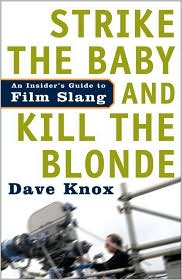
There are a number of reference books that I use on a regular basis and will discuss in later blogs. But one book that everyone must have is "Strike the Baby and Kill the Blonde: An Insider's Guide to Film Slang," by Dave Knox (Three Rivers Press, Copyright 2005). This book is both informational and entertaining.
It will help you answer such questions as: "Who needs a 'Twelve-Step' more, a 'AD' calling for a 'Martini' or a 'Grip' with a 'cappuccino'?"
You will find the answer to this and other fun facts in this easy to read insider's guide. But reader's beware: It is written from a New York filmmaker's perspective, so not everything translates to the West Coast. (Seriously, who calls a platypus a pelican?) But all in all, it is a great book to have around if you are a veteran and a must-have if you are just getting into the business.
The book is available for about $13 (in store) or less online. It can be found at Barnes and Noble or Borders/Amazon.
And...Cut!
Tuesday, March 11, 2008
Panasonic HVX 200 and P2 workflow
Now that I am finished shooting and editing Zed Lapel Pin I have a few thoughts and reflections on the camera and tapeless workflow. (From a producer's perspective)
I was a huge fan of the Panasonic DVX 100 (http://www.panasonic.com/business/provideo/app_dv.asp) when it came out and I am almost as big a fan of the Panasonic HVX 200 (http://www.panasonic.com/business/provideo/hvx200microsite/index.asp). As far as image quality goes, the HVX is great, it really is the HD version of the DVX. Some of my friends have complained that it doesn't shoot 1080, but I shot Zed in 720 and am very happy with the results. (you can see sample footage at www.zedlapelpin.com)
For as much as I love the picture from the HVX, I am not 100% happy with the tapeless workflow. And my dissatisfaction is mostly my fault. I wasn't able to put an assistant editor on the shoot to manage the cards, so I had to dump the cards each night. (Note for producers: Never agree to do this!!!!) After our first day of shooting, I took the cameras home and left a card in both cameras. That footage is permanently gone. :( Fortunately there was enough footage to keep me covered, but it sure would have been nice to have that footage.
So, I guess I have two complaints about tapeless:\
1) It adds an extra person to the crew to manage the cards (This is a must have position - I dont care if you use a PA, just have someone who can be there for the entire shoot)
2) Once the cards are formated, the footage is gone forever. (This just scares me)
Maybe I am too old school, but I like having a stack of tapes that I know the footage is on. Even if I have to store the tapes, I know the footage is there.
Also, once you download the contents of the card you have to have a hard drive to store it on. Forever. [Insert scene from "The Sandlot"]
There is an alternative to shooting on P2 cards, you can shoot directly to a hard drive via firewire such as the Focus FS-100 (http://www.focusinfo.com/solutions/catalog.asp?id=150) This product allows you to spend more time shooting and less time swapping cards. It also makes your assistant editor's life easier. I haven't tested this personally, but I have heard rumors that if you shoot to a hard drive you can also shoot to tape for back-up.
My final verdict on the HVX and tapeless: like, don't love it...yet
3/20/08 Update
I just read a great article on audio and tapeless workflow http://www.studentfilmmakers.com/news/article_1593.shtml I have also been getting lots of emails and phone calls about audio issues with the RED camera.
Thank you all for participating in this discussion, and feel free to post comments on the blog.
I was a huge fan of the Panasonic DVX 100 (http://www.panasonic.com/business/provideo/app_dv.asp) when it came out and I am almost as big a fan of the Panasonic HVX 200 (http://www.panasonic.com/business/provideo/hvx200microsite/index.asp). As far as image quality goes, the HVX is great, it really is the HD version of the DVX. Some of my friends have complained that it doesn't shoot 1080, but I shot Zed in 720 and am very happy with the results. (you can see sample footage at www.zedlapelpin.com)
For as much as I love the picture from the HVX, I am not 100% happy with the tapeless workflow. And my dissatisfaction is mostly my fault. I wasn't able to put an assistant editor on the shoot to manage the cards, so I had to dump the cards each night. (Note for producers: Never agree to do this!!!!) After our first day of shooting, I took the cameras home and left a card in both cameras. That footage is permanently gone. :( Fortunately there was enough footage to keep me covered, but it sure would have been nice to have that footage.
So, I guess I have two complaints about tapeless:\
1) It adds an extra person to the crew to manage the cards (This is a must have position - I dont care if you use a PA, just have someone who can be there for the entire shoot)
2) Once the cards are formated, the footage is gone forever. (This just scares me)
Maybe I am too old school, but I like having a stack of tapes that I know the footage is on. Even if I have to store the tapes, I know the footage is there.
Also, once you download the contents of the card you have to have a hard drive to store it on. Forever. [Insert scene from "The Sandlot"]
There is an alternative to shooting on P2 cards, you can shoot directly to a hard drive via firewire such as the Focus FS-100 (http://www.focusinfo.com/solutions/catalog.asp?id=150) This product allows you to spend more time shooting and less time swapping cards. It also makes your assistant editor's life easier. I haven't tested this personally, but I have heard rumors that if you shoot to a hard drive you can also shoot to tape for back-up.
My final verdict on the HVX and tapeless: like, don't love it...yet
3/20/08 Update
I just read a great article on audio and tapeless workflow http://www.studentfilmmakers.com/news/article_1593.shtml I have also been getting lots of emails and phone calls about audio issues with the RED camera.
Thank you all for participating in this discussion, and feel free to post comments on the blog.
Subscribe to:
Posts (Atom)